Platform Architecture
Overview
EKYC Solutions Co. Ltd., provides a modular architecture for identity verification and biometric identification. It is designed to support a wide range of use cases, from digital customer onboarding to large-scale biometric de-duplication.
The platform is composed of client-side SDKs for secure identity data capture and backend services for verification, matching, and identity management. These components can be integrated independently or together, depending on the requirements of the system.
At a high level, EKYC Solutions, Co. Ltd., supports two product families:
- EKYC Solution – focused on identity onboarding and verification workflows
- ABIS Solution – focused on biometric verification and identification at scale
High-Level Architecture
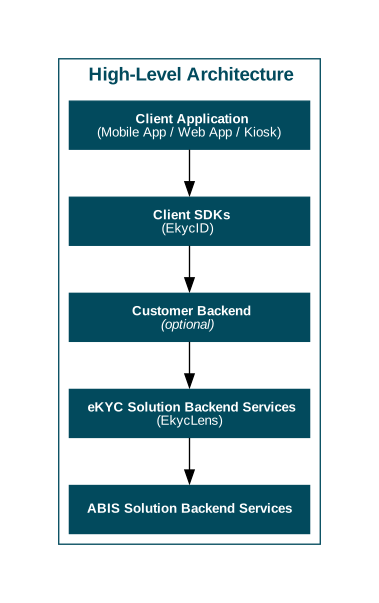
A typical deployment includes the following layers:
NOTE
Not all integrations require every layer.
For example:
- Some applications integrate directly from the client SDK to EKYC backend services.
- Enterprise and government deployments commonly route traffic through a customer-managed backend.
- ABIS is always integrated as a backend service and is not exposed directly to end users.
Core Platform Components
Client-Side Components: EkycID SDKs EkycID provides client-side SDKs for mobile and web platforms. These SDKs are responsible for:
- Capturing identity documents (e.g. national IDs, passports)
- Guiding users through document scanning
- Capturing facial images and liveness videos
- Performing real-time user guidance during capture
- Providing customizable UI components
All capture operations run on the user’s device. EkycID does not perform identity matching or biometric search.
Backend Components
EkycLens (EKYC Backend APIs)
EkycLens provides backend APIs used during identity verification flows, including:
- OCR processing for identity documents
- Face comparison between document photos and live captures
- Video-based liveness analysis
These services process captured media and return structured verification results to the integrating system.
ABIS (Automatic Biometric Identification System)
ABIS is a backend-only biometric system designed for identity verification and identification at scale. It supports:
- Biometric enrollment
- 1:1 biometric verification
- 1:N biometric identification (de-duplication and search)
- Multimodal matching using face and fingerprint data
ABIS is typically used in government, financial, and enterprise systems where biometric identity must be verified or searched across large databases.
Client vs Backend Responsibilities
The platform follows a clear separation of responsibilities:
| Responsibility | Client (EkycID SDK) | Backend EkycLens | Backend ABIS |
|---|---|---|---|
| Document capture | ✓ | ||
| Liveness prompts | ✓ | ||
| UI and user guidance | ✓ | ||
| OCR processing | ✓ | ||
| Face comparison | ✓ | ||
| 1:1 biometric verification | ✓ | ||
| 1:N biometric identification | ✓ | ||
| Biometric database management | ✓ |
Client components focus on secure, guided data capture, while backend services handle processing, matching, and identity decisions.
Data Flow Overview
Typical eKYC Data Flow
- A user captures their identity document and face using the client SDK.
- Captured media is sent to backend verification services.
- The backend performs OCR, face comparison, and liveness analysis.
- Verification results are returned to the integrating system.
- The system applies business rules (auto-approve, manual review, or rejection).
Typical ABIS Data Flow
- Biometric data is submitted to ABIS from a backend system.
- Biometric templates are generated and processed.
- A verification (1:1) or identification (1:N) operation is executed.
- Match results or candidate lists are returned to the calling system.
Biometric matching and search operations always occur in backend services.
Deployment and Environments
The platform supports multiple environments to facilitate development and production use:
- Sandbox Environment: Used for integration testing and development.
- Production Environment: Used for live identity verification and biometric matching.
Sandbox and production environments are logically isolated and use separate credentials. Integrations typically begin in sandbox and are promoted to production once testing is complete.
Integration Patterns
The platform supports multiple integration patterns depending on system architecture and regulatory requirements.
Common Patterns:
- Client → EKYC Backend: Suitable for lightweight applications and rapid integration.
- Client → Customer Backend → EKYC Backend: Common in regulated environments where backend control is required.
- Customer Backend → ABIS Backend: Used for verification, identification, and de-duplication in large-scale systems.
The choice of pattern depends on factors such as compliance requirements, transaction volume, and system ownership.
Key Design Principles
The platform architecture is guided by the following principles:
- Clear separation between data capture and identity processing
- Backend-only biometric matching and search
- Modular product design (EKYC and ABIS can be used independently)
- Privacy-aware handling of identity and biometric data
- Scalability for high-volume verification and identification use cases
These principles allow the platform to support both consumer-facing applications and large-scale enterprise or government systems.